AMPHIBIANS OF THE ARCHIPELAGO

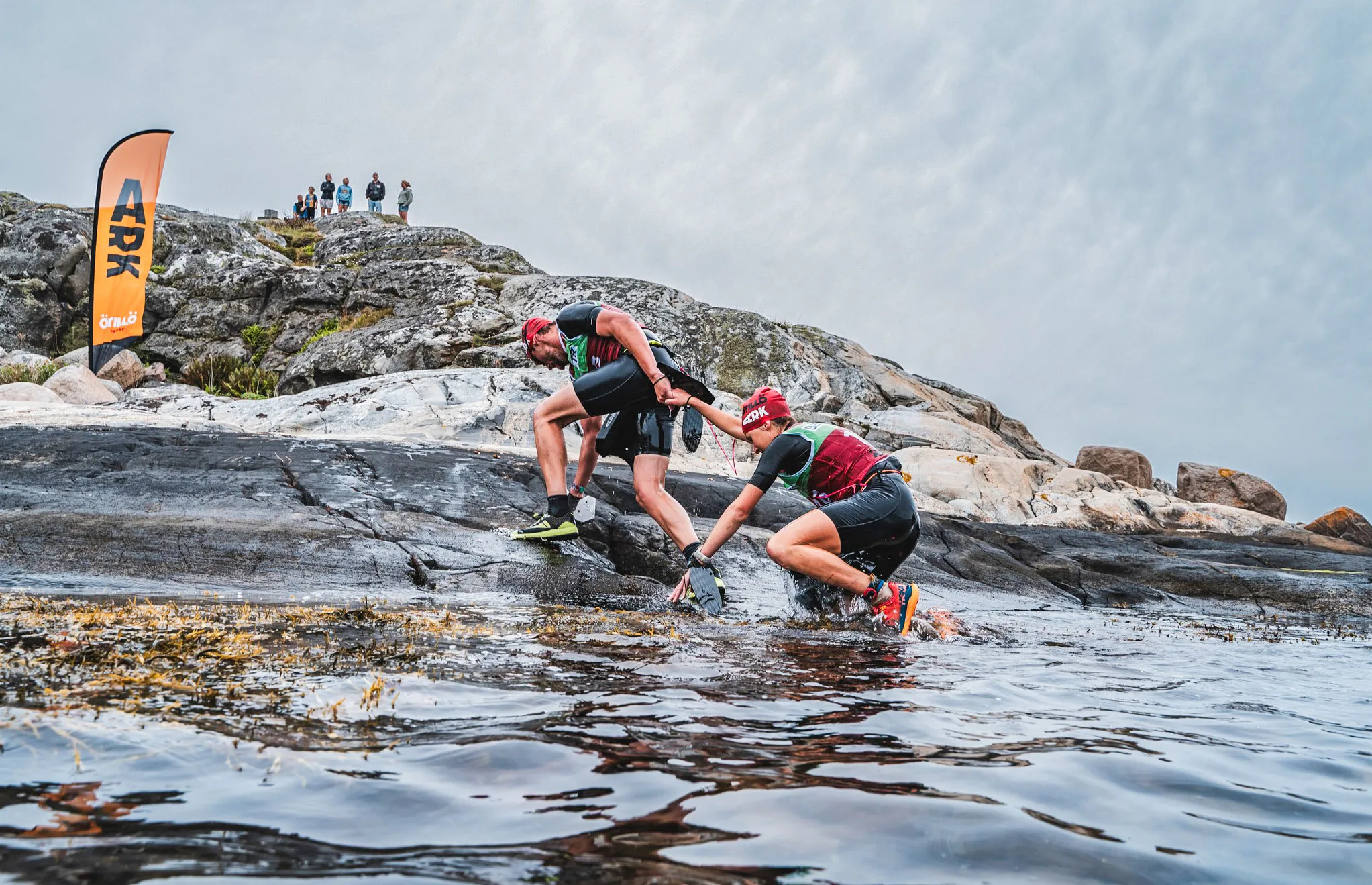
The Stockholm Archipelago is the home of Ötillö, a swimrun challenge considered one of the world’s toughest endurance events. Beginning at dawn, pairs must traverse the route’s 24 islands before dusk. To do so, they must negotiate 46 transitions involving 6 miles of open-water swimming and 38 miles of trail running. In 2023, physiotherapist Amanda Nilsson and firefighter Adriel Young sought to become the event’s first mixed-gender team to make the overall podium…

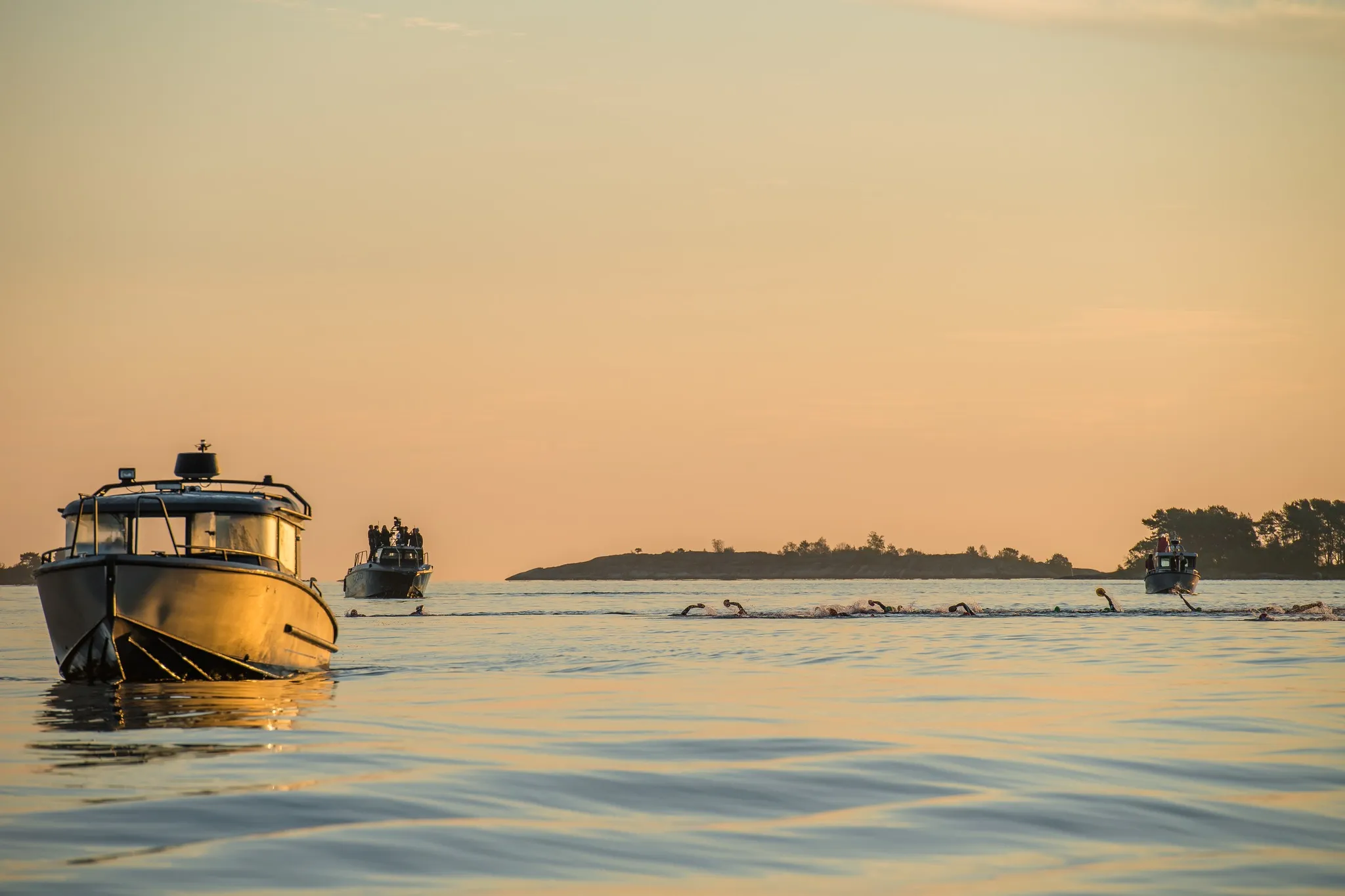
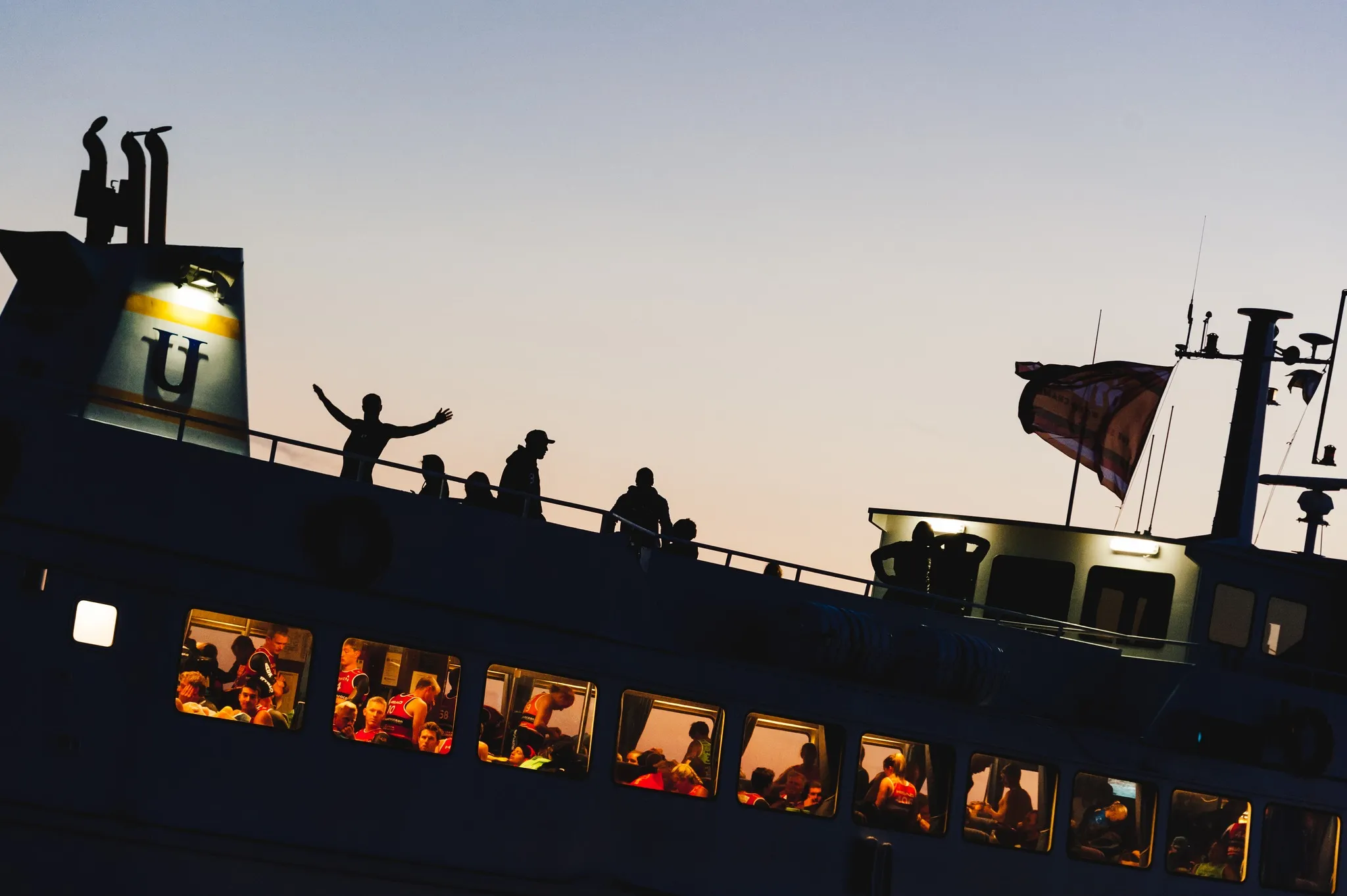
5.00AM: While the rest of Sweden sleeps, the tiny island of Sandhamn is yawning. Though the sun is yet to rise, the settlement’s population of 100 is about to quadruple. A small flotilla makes its way from the neighbouring island of Djurö, heaving with peaceful invaders whose armoury includes pull buoys, hand paddles, and goggles.

The rubber swishing of 300 wetsuits masks nervous chatter as ferry spotlights cast glimpses of the imminent battleground. Soon, daybreak will lift the gloom over the Stockholm archipelago and the Ötillö Swimrun World Championship will begin.

Amanda Nilsson and Adriel Young are among the fidgeting dawn raiders. Nilsson discovered the sport of swimrun when it passed through her Baltic Sea hometown of Karlshamn in 2017. Young is a former Bondi Beach lifeguard, complete with backwards cap and gnarly stubble.

Whereas the Aussie is a natural in the water, the Swede is a trail-running physio who fought her fear of the sea to begin swimming just six years ago. Ordinarily, there are 10,000 miles, nine years, a native language, and a gender separating them. But today they are one, umbilically tethered by a fluorescent pink nylon rope.

It’s not their first time together at Ötillö. But  minutes before the race begins isn't the time to discuss what happened last year. Instead, they wait in silence and allow the emerging sun to warm their twitching muscles.

“There’s this amazing energy. Everyone’s super nervous,” recalls Young. “People are quiet, trying to focus on what’s about to happen.” He downs an energy gel moments before the gun fires at 6am. Hundreds of athletes then dash towards the beach.

A minute later, Sandham is restful once more. The invaders have gone, engaged in a frenzied mile-long slosh towards the island of Vindalsö.

▾ As the sun rises, a ferry makes its way from Djurö to the tiny island of Sandhamn, heaving with swimrunners ready to tackle Ötillö in pairs

2002: Like all good origin stories, Ötillö owes its creation to a drunken bet. This wager occurred between four friends on the archipelago’s outer island of Utö. A mere 6 miles long and 3 miles wide, Utö has around 200 inhabitants, one main road, and a school with only 20 kids. As the home to Sweden’s oldest iron mines, its Holmquistite rocks are one of the rarest minerals on the planet, proudly on display in the island’s tiny museum. Until one evening at the Värdshus Hotel in 2002, this black ore was the island’s most famous export.

The hotel’s napkins feature a map of the Stockholm archipelago, showing Utö as the furthest island to the south. At the top is Sandhamn, some 43 miles to the northeast. Admiring the serviettes that night were visiting brothers Mats and Jesper Andersson, who were enjoying the hospitality of hotel owner Anders Malm and his friend Janne Lindberg.  Having imbibed their way past the threshold when such ideas are considered irrational, the group decided to pair up and race each other to Sandhamn the next day.

Cars, boats, bikes, or rafts were strictly forbidden. The losing team would pay for the following night’s drinks. Despite the hangovers, they persevered with their idea when they woke the next day. It took them 26 hours. Ötillö, meaning “island to island”, was born.

Transformed into a commercial entity in 2006 by race directors Michael Lemmel and Mats Skott, Ötillö series events are now held all over the world, but the original course remains the home of the annual World Championships, held on the first Monday of September. The course is essentially the return trip of that tipsy challenge, though competitors aren’t afforded the same amount of time as its founders. Starting at dawn, cut-off times throughout the route ensure that finishers will cross the line before dusk. In doing so, they’ll have traversed 24 islands and negotiated 46 transitions to cover 38 miles of trail running and 6 miles of open water swimming.

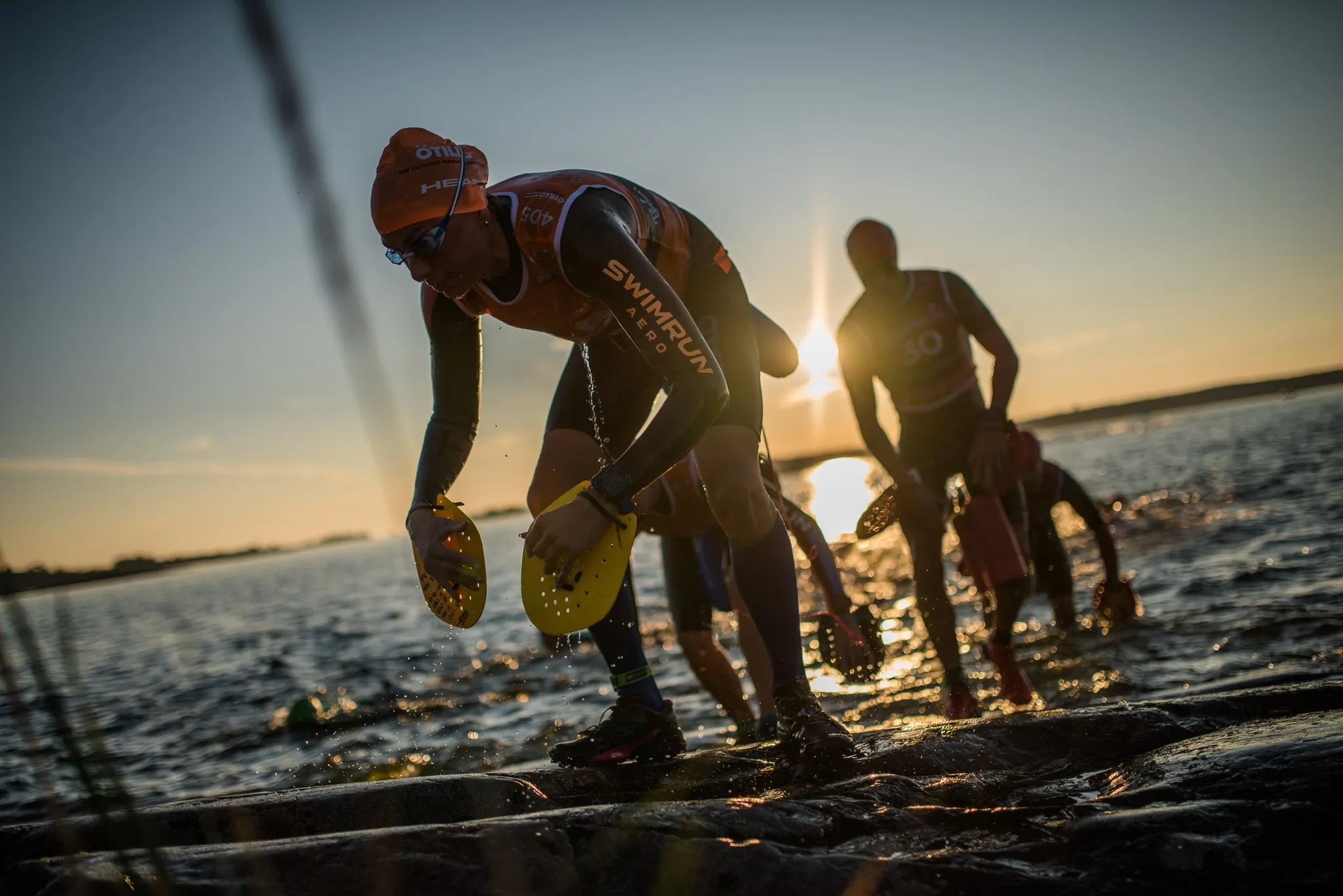
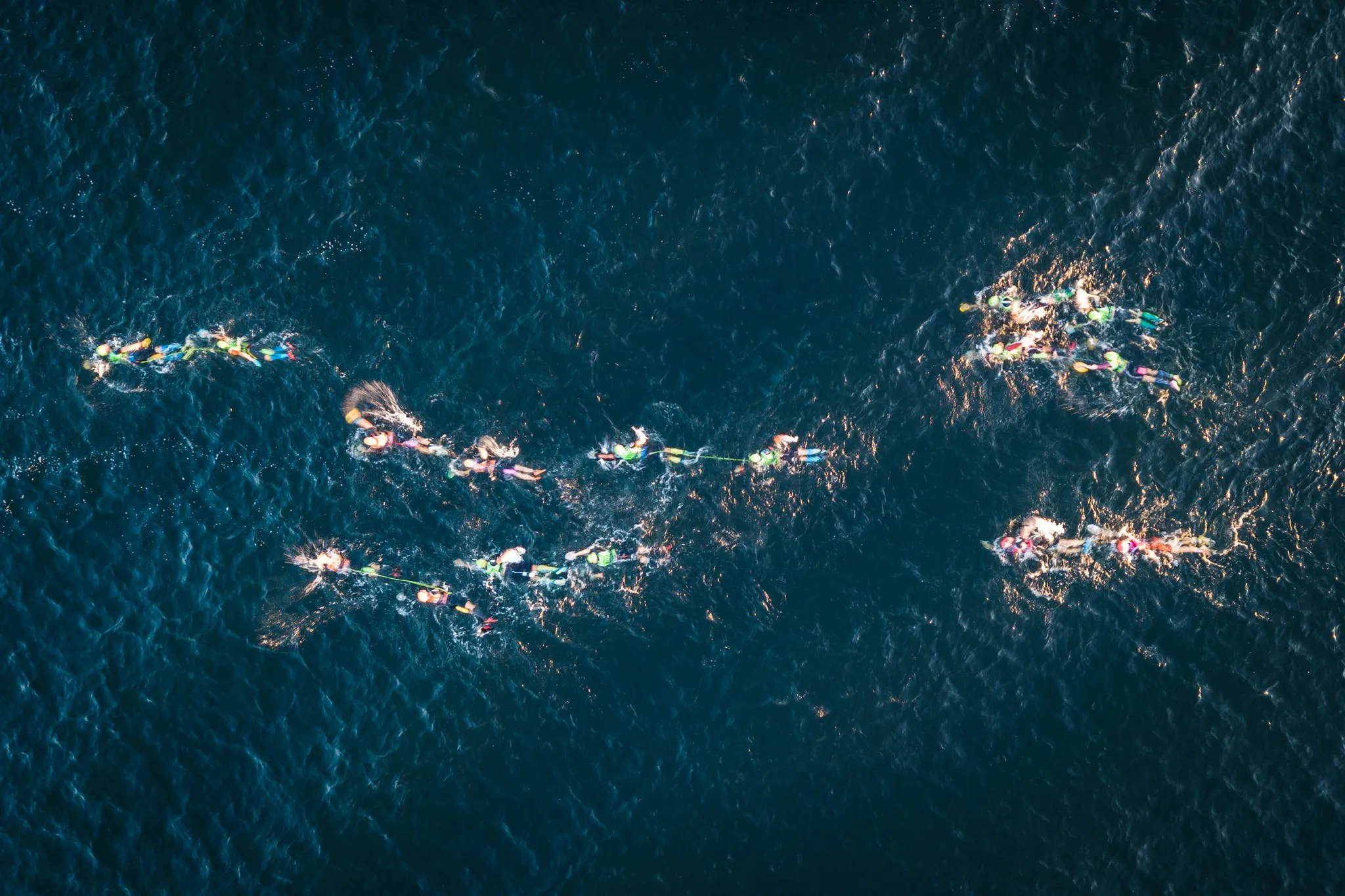
That task alone would make it one of the toughest endurance events on the planet. But there is one more factor to consider that puts to bed any thought of Ötillö as a triathlon without the bike. Athletes compete in teams of two, and each pair must remain within 10 metres of each other throughout the race. Failure to do so will incur time penalties. To ensure that they stay close together, especially during long stretches of choppy water swimming when drafting behind the stronger swimmer can provide a significant advantage, most teams choose to tie themselves to one another with paracord.

“Swimrun is a partnership,” says Young, who was an experienced triathlete in Australia before moving to Sweden in 2014. “You’re going through exactly the same thing at the same time. You’re doing it together, and that’s what sets it apart from triathlon. The tether is a nice way to be able to speak without words. You can really tell how your partner is doing just through the line, especially swimming when it’s hard to communicate.”

The physical challenges of completing this punishing course are considerable, and pairing up is a reassuring safety net in addition to the dozens of medical volunteers and lifeguards dotted throughout. But this is not the main reason the Ötillö organisers opted to go against the grain and leave no one behind.

According to former race director Lemmel, it’s about a shared experience. “We all know that racing over long distances is an emotional journey,” he told the Global Triathlon Network in 2022. “And you have shared that journey with somebody else. That will be with you for the rest of your life.”

Nilsson and Young will share every step, wave, slip, and setback. They'll tap into each other’s emotional reserves, seek solace when struggling or offer encouragement when the squelching shoe is on the other foot. Whether it takes eight hours or 12, whether finishing first or last, they will cross the line battered, bruised, exhausted, and together.

"Mentally, it’s so much easier when you’re two together in a team"
▾ Ötillö series events are now held all over the world,but the original course remains the home of theannual World Championships, held in September

6.01AM: The first swim is the longest and most frantic of the day. It’s the only point when every competitor plunges into the water at once, resembling a panicked shoal of herring escaping the jaws of a prowling shark.

For those athletes with ambitions of victory, it is already vital that they get as far in front as possible. They can’t afford to be sucked into the vortex of swinging elbows and churning white surf. “Everyone wants to be at the front. People are pushing, everyone wants their own space,” says Young, stressing that it’s more instinctive than menacing.

As it’s still dusk, swimmers flock towards a flashing strobe that guides them. This human lighthouse appears dauntingly distant at first glance. “It looks so far away,” admits Young. “But the moment you hit the water there’s a relief and the nerves just disappear. Now we know what we’re doing. We’ve done this a thousand times, we just have to do what we do best. It’s usually pretty cold in the water as well.”

One of the reasons the race is held in September is to avoid the high-season boat traffic during Sweden’s summer months. But it means wetsuits are necessary: at 13 degrees the Baltic Sea can live up to its name when the athletes first dive in.

Nilsson and Young get off to a solid start. They follow the feet of French pair Tom Ralite and Matthieu Poullain, enjoying the benefits of the men’s slipstream until they're snagged on a rock and are forced to navigate the last half mile on their own steam.

By the time they’ve reached Runmarö, island number three, they’ve been in the water four times and ran over six stretches of land to find themselves the leading mixed team. They’re also fourth overall behind three all-male teams.

“Adriel leads the swim, as he is a stronger swimmer than I am,” admits Nilsson, adding that she loves the thrill of the mixed category. “If I was competing alone against Hugo and Max [world champion male pair Max Andersson and Hugo Tormento], I wouldn’t be able to keep up with them. It’s so much fun to be able to compete with men who are a lot better than me, and keep up with their speed thanks to Adriel.”

Aged 26, Nilsson has good reason to position Young, 35, as the senior partner. He’s competing in his sixth Ötillö World Championship and is a three-time winner, twice in the mixed category and again in the men’s division in 2021. By comparison, this is Nilsson’s third Championship showing, but Young stresses that it takes two to tango.

“Amanda leads the running,” he reveals. “She drags me!”. Nilsson’s protestations suggest that she disagrees with her elder teammate’s modest analysis, but there can be few doubts about their combined strengths and past performances. They’ve enjoyed multiple World Series wins already this season, making the pair strong favourites for the mixed title.

The only drawback for Nilsson is Young’s “shoey” celebration, an Australian tradition which sees the victors quaffing champagne from a sweat-drenched running shoe. If they claim the title today, she’ll happily indulge her Aussie teammate once more.

9.43AM: Nearly four hours and ten islands in, they’re living up to the hype with a healthy 24-minute lead over the second-placed mixed team, Finns Teemu Toivanen and Heidi Hyvarinen.

The cushion in the mixed category offers a temptation to realign their ambitions. In 17 editions of the World Championship, no mixed team has ever finished on the overall podium. Traditionally, the event is dominated by all-male pairings. But right now, it’s a status quo that is being maintained by a single second.

While Andersson and Tormento are six minutes ahead of Ralite and Poullain, Nilsson and Young are so close to third-placed Swedes Lars Ekman and Daniel Hansson that they’re able to draft in their wake. If a desire to write their names on this blank page of Ötillö history isn’t implicitly discussed by this humble partnership, then it’s subconsciously acknowledged.“There are some pairs that talk and pepper each other the whole way,” says Young. “Then you can race beside another team that don’t say a word to each other. Amanda and I chat a little bit but we’re pretty focused when we’re racing. It’s a balancing act. Usually, any conversation between us is discussing tactics, making sure the other person is eating, or asking how they’re feeling."

“Both of us can spot when the other is finding it tougher, but I think we are pretty good at keeping focus, pushing each other on, and helping each other out from those tough periods,” adds Nilsson.

Given the gruelling nature of the sport, injuries and late dropouts often forge ad-hoc unions. Nilsson and Young are a product of circumstance, having come together only days before a smaller swimrun in Utö in 2022. Their win that day proved not only their compatibility, but demonstrated the strength of a close-knit swimrun community.

“We met through racing and have a lot of mutual friends so it was natural that we race together,” says Young, who has retrained as a firefighter and lives 180 miles north of Nilsson in Gothenburg. “I had a lot of trouble in triathlon where it was very closed and you come to a race and no one really talks to you. Maybe it’s because it’s such a small sport at the moment, but when you come to a swimrun race it doesn’t matter who you are, everyone’s just like one big family. That’s a beautiful part of the sport.”

▾ Ötillö abides by a strict motto of leaving nothing behind except “footsteps and memories”

10.15AM: Beauty is in bountiful supply here, and the organisers aim to keep it that way. Since the first race in 2006, Ötillö abides by a motto of leaving nothing behind except “footsteps and memories”. Participants mistaking this for some fluffy marketing spiel do so at their peril. Any athlete caught littering is disqualified. “Sustainability is a big part of swimrun,” says Nilsson.

“Most races focus on the environment. You have to carry your own water bottle and all your rubbish right to the end. Everything you start with in the race you have to finish with,” adds Young. “If you drop something you can get a time penalty. There were people that used flippers one year, and they threw them in a bin along the way. You’re not allowed to do that. You can’t just use something to help you on the first long swim and then get rid of them after.”

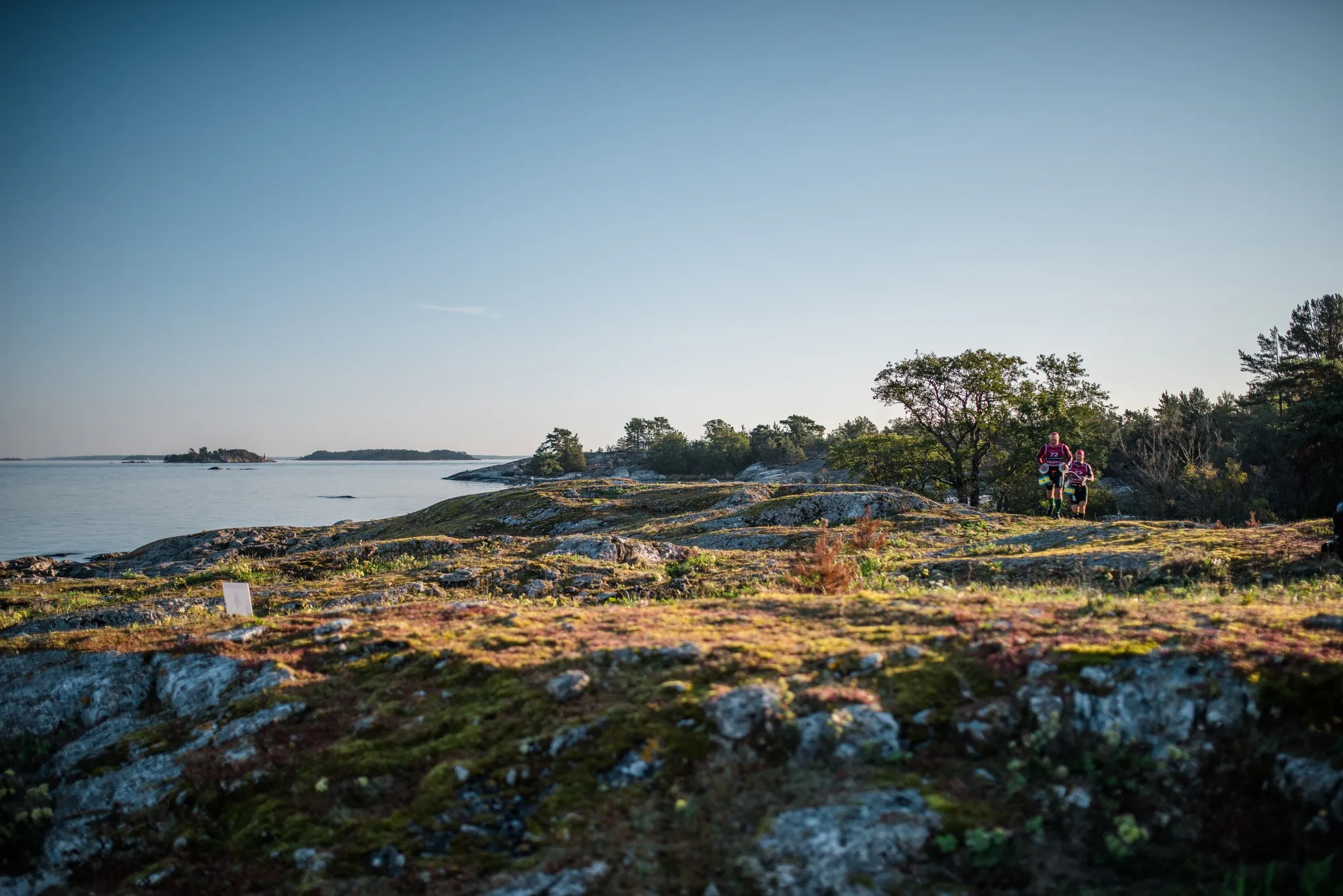
Choosing your equipment is a balancing act aligned to the shifting geography. No island is alike, each with its own personality and pitfalls. Some are kind enough to have paved roads on which to run, others merely narrow gravel tracks. There are unmarked and overgrown routes that test your navigational instincts, a fiendish mental task in the midst of physical toil. Uneven trails demand a four-limbed scramble. Steep and slippery rocks require a roped descent. This isn't switch off and run fast in a straight line. This is switch on and run savvy, like you’re dodging a sniper’s bullet.

Long distance running, uphill on uneven ground, cultivates a misplaced yearning for the sanctuary of the sea. But a minute in those wild waters will convert anyone into a landlubber once again. The notorious pig swim, the exposed water connecting the islands of Mörtö Klobb and Kvinnoholmen, might have a crow flies distance of just under a mile, but crows aren’t troubled by currents. For humans pushing back against a flow of 20 knots, it might as well be 3 miles.

The organisers proudly state that the wilderness dictates the distance at Ötillö. It’s what often throws clock-watching triathletes. They have a target time in mind but the only pacemaker here is nature.

“Some amazing triathletes have come to race Ötillö,” says Young. “But they get out of the water in the first swim and stand up on slippery rocks and cobbles realising it’s not what they expected. They’re trying to hold a pace that they're used to, but they can’t. You are out in nature and there’s no set course. In triathlon, everyone knows their time and you’re following your clock and your heart rate. With swimrun, the course is so dependent on nature. It’s a nice wake-up call for people when they come here.”

This is an endurance event that rewards all-rounders. The unflustered and adaptable who can swim the rough and run the rugged. Like Nilsson and Young, whose native training in these conditions pays off as they survive the pig swim unscathed. With a half-hour lead over the Finns in the mixed competition, an epic duel with male pair Ekman and Hansson is unfolding for a place on the overall podium and the chance to etch a new entry into Ötillö history. The gap behind is one second. But as they approach the island of Örnö, they have new demons to fight.

2022: By almost any metric, Nilsson and Young’s first World Championship together in 2022 was a success. They earned the silver medal in the mixed category, crossing the finish line in under eight hours. But there is little joy from either athlete when they recall that experience.

“In the World Championships last year, I struggled a lot in that race,” admits Young. Nilsson is quick to chime in with, “Me too”, as their collective tone lowers. “We didn’t have the best performance, especially in the second half of the race. We were leading until the last quarter, when there’s a long run.

"And that’s where it went a bit pear shaped,” he adds with a pained chuckle that suggests he has no appetite to get into the details. With over five hours on the clock, the pair had a one-minute lead over their closest rivals, Swedes Alexander Berggren and Desiree Andersson, the latter a multiple-winning Ötillö legend. But by the time they'd traversed the undulating 10 mile trail through the woodlands of Örnö, they’d enter the water over two minutes behind, having watched Berggren and Andersson power past them.

With two hours to go, as the leaders became dots in the distance, they knew their chance of victory had gone. “They went past us there. And we had to simply hold it together for second place,” says Young, eventually finishing nine minutes behind the winners. “It was a big disappointment. But it’s important to remind yourself that we’re on the world’s biggest stage of our sport, and coming second isn’t so bad,” he adds less convincingly. “But we wanted more.”

The post-race inquest wasn’t held in anger or bitterness. Rather in that barely verbalised subtleness that defines their relationship. Maybe they hadn’t eaten enough in the morning, or failed to take in enough gels at energy stations. Maybe they’d pushed themselves too hard on the gravel tracks of Runmarö and Nämdö.  

All they knew was that their tanks were close to empty before they’d got the chance to glide through the technical terrains in which they thrive. They told each other that next year would be different.

11.20AM: The duo emerge from their latest swim, a sheltered and relatively calm 300-metre hop from Kymmendö, with a three-second lead over the Swedish men. But as their feet touch the dry land of Örnö, their thoughts return to the last time they were on this unforgiving 18th island. Whatever happened over that torrid hour a year ago cannot happen again if they’ve any chance of making the podium.

“It’s really important to be lucky that you don’t both have a dip at the same time,” says Young, as Ötillö’s unique double-act format becomes the defining factor as the race progresses. “It’s so nice to have someone with you that can pull you out of that dip. And when we’re racing for eight hours, you will have a dip. It’s the job of your partner to pull you out of that hole.”

“Mentally, I think it’s so much easier when you’re two together in a team,” says Nilsson. “I always push myself more when I compete together with someone else than when I’m competing alone.”

Revitalising words at this stage need not have the precision of a sports psychologist nor the sentimentality of a cat poster. Simply stating the obvious can have the desired effect. “I like to remind them about how good they are as an athlete and how good they’re going to feel in 10 minutes from now,” explains Young. “As Amanda says, it’s much easier to give up when you’re by yourself. But you’re able to find that extra 10% to give to your teammate.”

The tether also plays a pivotal role when pairs are experiencing contrasting fates. A taut rope can become a welcome tow for the straggler and, for the athlete on the up, a way of transferring their strength.

“Deciding on the length of the tether is important because if it’s too long one person is doing too much work at the front, but too short and then it’s too hard for the person at the back,” says Young. “Last year we had a bit of trouble with our tether in a few races and we spent some time adjusting that until we found something that worked perfectly for us.”

“Sometimes it has been wrapped around my pull buoy, which has made it shorter in some swims. And it can get stuck in branches when running on land,” adds Nilsson, giggling at the memory that follows. “In Cannes we chose different sides around a tree!”

Just over halfway into the run on Örnö and the tether remains encouragingly loose. There’s no sign of any struggle, but their pursuers have cut the deficit to a single second. Nilsson and Young can hear the advancing footsteps, just like last year in the moments before Berggren and Andersson powered past them. But this time, they have a strategy in place for this very scenario.

“We’ve learned that we need to get to Örnö as fresh as possible,” revealed Young on the eve of today’s race. “We’ll maybe take it a bit easier on the gravel runs, because we’re really good in the technical terrain. It’s on Örnö that we want to do damage.” Rather than fear the island on which it all went wrong last time, Young and Nilsson plan on taking it on.

They share a glance and, with 4 miles until the next swim, they begin their attack. They plunge towards the tiny islet of Kullbäling with a one-minute lead, which soon extends to three before they’re running again. Now it is they who have become the dots in the distance.

"when you come to a swimrun race it doesn’t matter who you are, everyone’s like one big family. That’s a beautiful part of the sport"

1.50PM: Nilsson and Young are only minutes away from the finish line. They’re set to be crowned mixed champions, but a historic spot on the podium is in serious jeopardy. The all-male Swedish team has cut the deficit to less than a minute.  Young’s shoulders are hunched, his green bib is crumpled and drenched. His jog seems relaxed but his face is pained. The only words he musters for the Ötillö cameras are a mumbled, “I’m pretty tired now”, before he asks about the remaining distance. He’s told there’s a mile to go. The rope behind him is taut.

At the other end of it Nilsson’s run appears more energetic, her ponytail bouncing jauntily. But that’s because her steps are heavy, and with each pace her elbows jut out in an exaggerated manner. She’s battling muscle stiffness.

A cyclist appears with the time split. The gap is 33 seconds. It prompts a guttural howl of, “Come on Amanda!” from Young, who glances behind before picking up the pace.  The blue skies and downhill gravel paths provide little natural resistance at this stage, but the same can be said for those behind them. Spectators stand outside red-tiled houses, applauding as the shattered runners trudge past. Then some cheering begins as they approach Utö harbour. As a Swedish flag blows in the gentle breeze, the chasing pair come into view. With 100 metres to go, they are only 10 seconds away.  

Young grimaces and powers on. He says nothing. The tether does the talking now. This non-verbal pep talk does the job as Nilsson stays at the pace required to beat the men in her shadows. “We heard that they were getting closer and closer,” says Nilsson. “Every step I was 50% sure that my legs would keep me up, and 50% sure that my legs would just drop down and I would fall. The last run was brutal, we just needed to keep it together.”

“That last run we were on the red line the whole way to try and hold them off,” admits Young. Just metres from the finish, he slows down to allow Nilsson to jog alongside him. They lock arms as they cross the line together as champions, then hunch down in unison to catch their breath. Their time is seven hours and 54 minutes.

Such is their margin of victory in the mixed category that the second-placed team will not arrive for another 38 minutes. More impressively, they’ve become the first mixed-gender team to finish on the overall podium. It is a hard-fought achievement, as Ekmann and Hansson arrive just seconds later. Having been desperate to keep a distance from each other all day, the four now embrace in mutual respect.

Winners Tormento and Andersson finished half an hour earlier in a monstrous display of power. The second-placed French team, whose feet Nilsson and Young lost in the opening swim, would finish less than five minutes ahead of the mixed champions.

The final team to cross the line do so in just under 14 hours. As finishers, their efforts are no less remarkable. Especially as 18 teams return home with a DNF next to their names, having fallen foul of Ötillö’s brutal charms.  

“When we finished before the men’s team that was hunting us, it was such a relief. But for the first few seconds, I didn’t feel that much. Just tiredness,” says Nilsson. “To win there was something we’d worked for for so long,” says Young, contrasting it with the rotten disappointment 12 months earlier.

“After missing it the year before, and knowing that we had executed the perfect race for us was such an amazing feeling. It’s one of those ones you can hold with you for a while.”

When he musters the energy to stand upright again, there remains only one thing left to do. Young removes his shoe, and Nilsson knows what’s coming next. The Aussie fills it with champagne and hands it, smiling, to his reluctant teammate.