miracle on ice

While Australia has been present at the Winter Olympic Games since the 1936 edition in Bavaria, it would take over six decades before their anthem would be heard while their flag was being raised. Speed skater Steven Bradbury was the man who emerged from Salt Lake City's icy melee in 2002 to prove that those born on red soil can flourish in a frozen kingdom...

With spiky blonde highlights and a jazz dot goatee decorating his angular jaw, Steven Bradbury looked every bit the Sydney surfer on the day that would change his life.

Bradbury arrived at the semi-final - the third race of the day - knowing that, as the second-oldest skater in the competition, he was going to struggle to match the pace of his younger, hungrier opponents. He told his coach he planned to stay at the back, enjoy the slipstream, and just hope for the best.

In sport, leaving anything to hope is seen as a loser’s privilege. The best don’t wait for greatness to happen to them, they march stridently on the path towards it. But, when three of his opponents crashed into each other - including defending champion Kim Dong-sung and multiple Olympic medallist Li Jiajun - Bradbury began to wonder if he was on to something as he crossed the line in first place, earning his unlikely place in the final.

Grab the bull by the horns? Nonsense. Wait til the beast has gored your rivals, then tickle its belly and read its weary soul a bedtime story.

In a matter of hours, Bradbury would be back out in front of a sell-out Delta Center. His tactic was set. Stay out of trouble. Let the others fight the bull.

As the five finalists lined up, American Apolo Ohno had 17,500 home fans cheering, convinced they’d be singing along to the Star Spangled Banner in a matter of minutes. South Korean Ahn Hyun-soo, Li Jiajun from China, and Canadian Mathieu Turcotte completed the field of five: all bar Bradbury were multiple world champions.

The nine-lap race began as expected: the Korean, Chinese, and American athletes tussled for position at the front, with the Canadian just behind in fourth. With three laps to go, the crowd screamed in a frenzy as Ohno made his move on the outside to take the lead. By that point, Bradbury was 10 metres behind the pack. With one lap to go, he was in a different postcode.
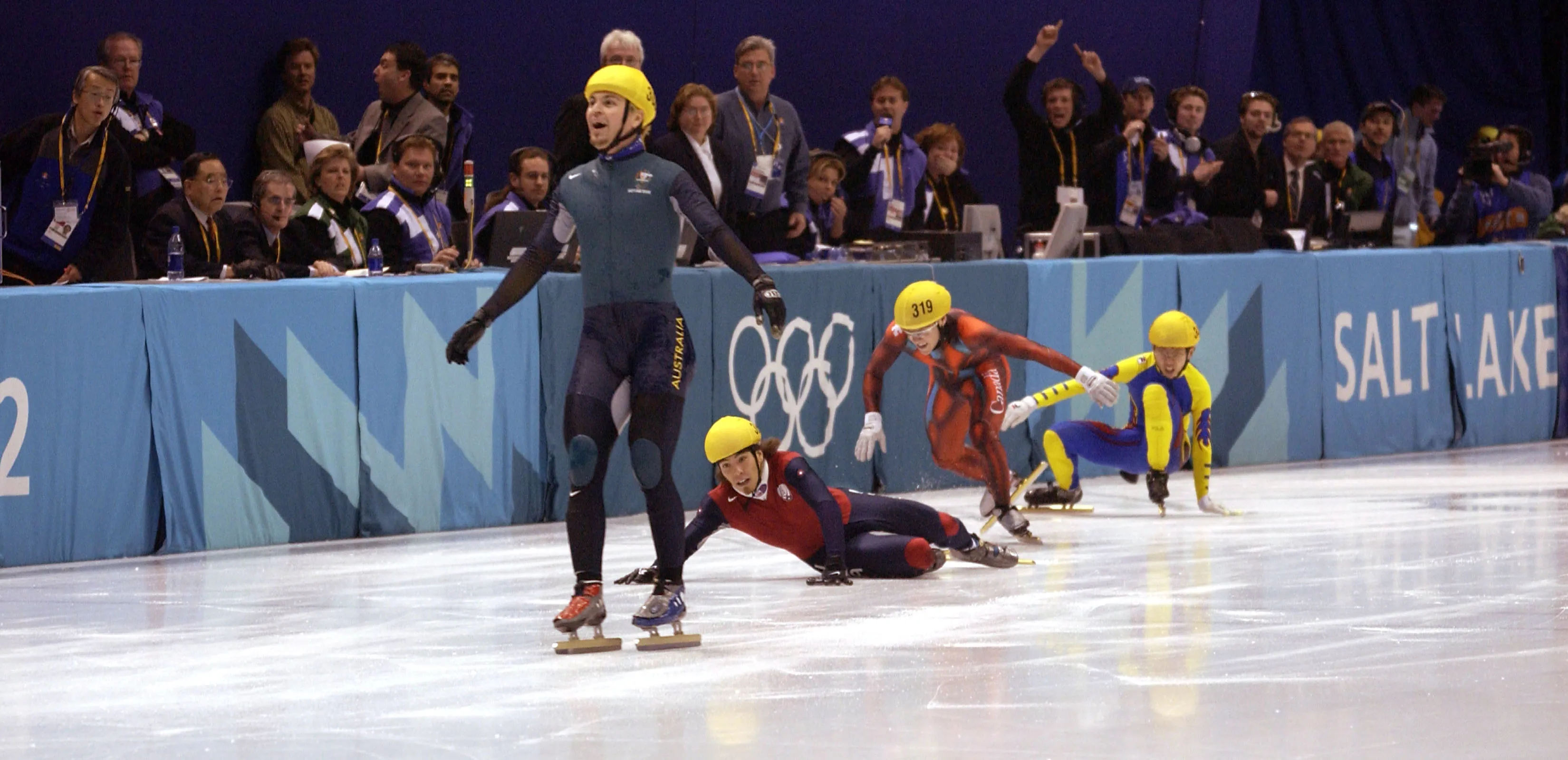
And then it happened. On the final bend before the finish line, Li Jiajun made a last ditch attempt to get past Ohno on the outside. At the same time, Ahn Hyun-soo tried his luck on the inside. Sandwich on ice. And Canadian Turcotte was close enough to eat it. All four skaters tumbled into the advertising boards, just metres from the line.

Bradbury, watching in disbelief as he took the corner with a clear road ahead of him, took a moment to realise what had just happened. Then he raised his arms aloft, and a cacophony of confused and angry Americans was the sweet soundtrack to Australian history.

Steven Bradbury had become the first athlete from Australia - and the entire Southern Hemisphere - to win a Winter Olympic gold. The next day, a still seething USA Today wrote: “The first winter gold medal in the history of Australia fell out of the sky like a bagged goose. He looked like the tortoise behind four hares.”

Australia couldn’t give a rats, mate. Their man had reigned in a frozen kingdom not built for those born on red soil. His stunned, beaming smile became the story of the Games. His humble words moments after victory only cemented his legend:

“It’s good, but it doesn’t feel right you know. I wasn’t as strong as the other guys out there, but I am going to take it. I came to these Games hoping to make up for opportunities where I didn’t skate my best. I consider myself the luckiest man.

“God smiles on you some days and this is my day.”

He’d retire from the sport the following year, safe in the knowledge he’d become a national icon. Fourteen years later, to “do a Bradbury” was added to the Australian National Dictionary.

This story was featured in Off-Field #30. For similar tales in your inbox every month, sign up to our newsletter